
Programming
The Art Deco Society of New York
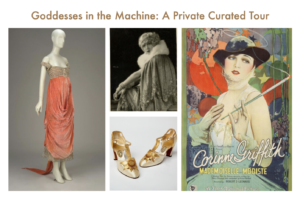
Goddesses in the Machine: A Private Curated Tour
When films were silent, fashion spoke volumes. Goddesses in the Machine, the first major exhibition to explore fashion in American silent film, reveals the untold story of costume and style in early Hollywood, from actors wearing their own clothes to the birth of the movie costume designer. Join us for this private and curated tour where we will learn how silent films transformed fashion from personal expression into powerful storytelling, creating the blueprint for modern movie glamour.
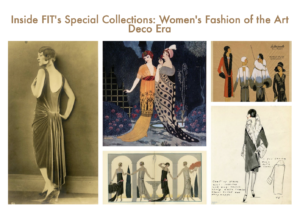
Inside FIT’s Special Collections: Women’s Fashion of the Art Deco Era
Join us at the Fashion Institute of Technology for a special curated archival overview of women’s fashions in the Art Deco era, led by fashion historian Raissa Bretaña. In this exclusive, members-only opportunity to see archival materials up close, Raissa will present fashion plates, period publications, original illustrations, and other materials from Special Collections and the FIT Archive. The overview will also highlight the work of some of the period’s most influential designers and illustrators, including Erté, George Barbier, Paul Iribe, and Paul Poiret.
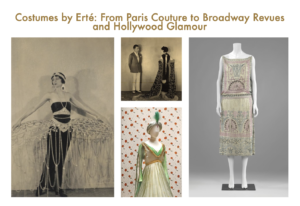
Costumes by Erté: From Paris Couture to Broadway Revues and Hollywood Glamour
Join fashion historian Summer Anne Lee for an in-depth look at the life and work of Erté, one of the most influential designers of the Art Deco period. Best known today for his highly stylized illustrations and fantastical fashion imagery, Erté profoundly influenced the world of performance costume. By highlighting Erté’s work for Broadway alongside his achievements in Paris and Hollywood, this talk emphasizes his work in New York City, where his costume designs for musical revues—including the Ziegfeld Follies—helped shape the visual language of the modern showgirl.
FIT Fashion History Club
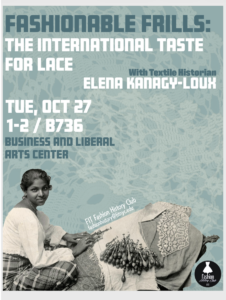
“Fashionable Frills: The International Taste for Lace” with lace historian Elena Kanagy-Loux
Scholarship on the history of lace has enjoyed a surge in popularity in recent years, yet
lace produced and worn outside of the early modern Western European canon continues to be
excluded from the mainstream narrative. This narrow focus belies the fact that elaborate
openwork textiles can be found across a much broader temporal and geographic range, as human
beings around the globe have exhibited an inherent desire to adorn their bodies for millennia. This lecture will expand on the definition and framework of lace to offer a multifaceted perspective on its sartorial history, from interlaced garments of the Andes to Caribbean lacebark accessories.
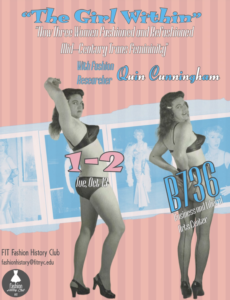
“The Girl Within: How Three Women Fashioned and Refashioned Midcentury Trans Femininity” with fashion researcher Quin Cunningham
This presentation explores shifts in trans feminine expression from the 1950s to the 1960s through print media created by and about three trans women: Christine Jorgensen, who became widely known for introducing transsexuality to the American public in 1951; Coccinelle, the French cabaret star whose groundbreaking 1962 marriage helped bring her blonde bombshell style to the United States; and Denise, whose six scrapbooks from the 1950s–70s preserve images and articles about trans icons, performers, friends, clothing, adornment, and cosmetic transformation.
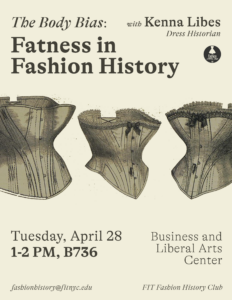
“The Body Bias: Fatness in Fashion History” with dress historian Kenna Libes
Diverse body types have always existed, but plus-size clothing is often purposefully excluded from fashion history and museum exhibits. In this presentation, dress historian Kenna Libes considered how this affects the way we understand our past. Contrary to what we often see and are taught, plus-size fashion is not an emerging product of our own time, but in fact has a longer—and possibly more inclusive—history than you might expect.
Flyer by Anika Sud
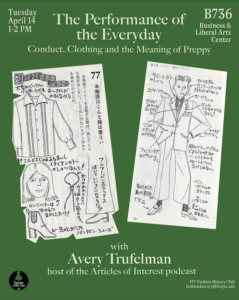
“The Performance of Everyday: Conduct, Clothing, and the Meaning of Preppy” with Avery Trufelman, host of the Articles of Interest podcast
Described by Avery as the “most incredible fashion arc of the 20th century,” Ivy style traces American ideas of taste, class, and democracy. Originating as a niche look at Princeton, it evolved into a widely adopted, all-purpose style worn across genders. This talk explored how clothing reflects social and political contexts, frames identity and belonging, and uses Ivy style to question what “timeless” and “normal” dress really mean.
Flyer by Anika Sud
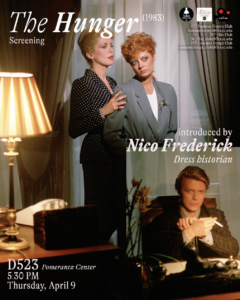
Screening of The Hunger (1983) introduced by dress historian Nico Frederick
Frederick’s introduction explored the costume design of the sapphic bloodsucker, tracing the early filmic origins of this archetype, the so-called “golden age of lesbian vampire films,” and The Hunger’s enduring impact on both the queer film canon and fashion history. The talk also examined why fashion lovers continue to return to this film with such bloodlust.
Flyer by Anika Sud
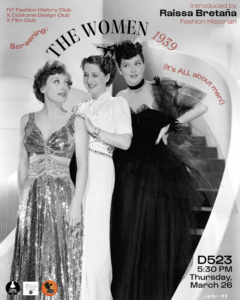
Screening of The Women (1939) introduced by fashion historian Raissa Bretaña
Fashion historian Raissa Bretaña examined the dazzling costumes worn by the film’s all-female cast, designed by MGM’s head costume designer Adrian. She drew parallels to contemporary fashion during the time of the film’s release, and chronicled Adrian’s legacy as a pioneering American designer from his tenure at MGM (1928–1941) to his career as a couturier in the 1940s.
Flyer by Anika Sud
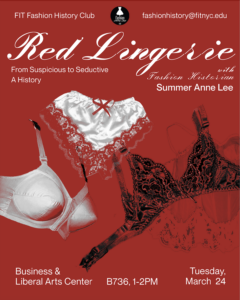
“A History of Red Lingerie: From Suspicious To Seductive” with fashion historian Summer Anne Lee
When did red lingerie come to signify seduction and scandal? In this illustrated lecture, fashion historian Summer Anne Lee traces how colorful undergarments shifted from being deemed improper in the Victorian period to acquiring romantic and erotic meanings after the Second World War.
Flyer by Anika Sud
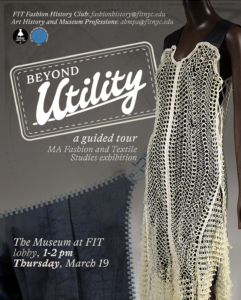
Guided tour of FIT MAFTS exhibition Beyond Utility
Beyond Utility examines utilitarian design within and beyond the fashion system. This investigation of dress archetypes of workwear, military uniforms, and craft alongside their reinterpretations reveals the interplay between materials, aesthetics, and cultural connotations. By exhibiting objects that have unique biographies and lived-experiences, Beyond Utility demonstrates how these objects have life imprinted on them, and evidence of wear and labor only enriches their stories.
Flyer by Anika Sud
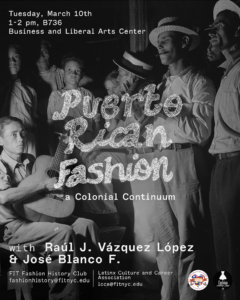
“Puerto Rican Fashion: A Colonial Continuum” with Raúl J. Vázquez López and José Blanco F.
Historians Raúl J. Vázquez López and José Blanco F. talk explored how Puerto Rico’s colonial status has shaped its fashion history and identity, from traditional jíbaro dress to Miss Universe pageantry and Bad Bunny’s global stage. This event was co-hosted by the FIT Latinx Culture and Career Association.
Flyer by Anika Sud

Guided tour of MFIT’s Art X Fashion with associate curator Elizabeth Way
The Fashion History Club and the Art History & Museum Professions Association co-hosted this guided tour of MFIT’s Art X Fashion exhibition with curator Dr. Elizabeth Way. Featuring over 140 objects from MFIT’s permanent collection, the exhibition explores the long-standing, symbiotic relationship between fashion and fine art—challenging the question, “Is fashion art?” Through garments, artworks, and historical styles from Rococo to Pop Art, Art X Fashion presents fashion as a powerful cultural, creative, and intellectual force.
Flyer by Anika Sud
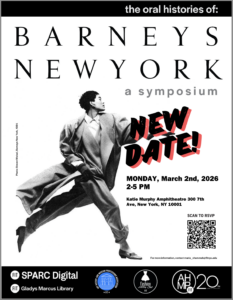
The Oral Histories of Barneys New York: A Symposium
Developed in response to a perceived sense of loss surrounding the closing of a beloved New York institution, the Barneys Oral Histories were created to preserve memory and meaning. These interviews give voice to the people who worked there—buyers, creative directors, advertising executives, and visual merchandizers—whose labor shaped Barneys’ singular identity. The Barneys Oral Histories Symposium examines shopping in New York in the 1980s and the production of New York culture through the department store catalogs. It also explores the Fashion Calendar and how parties, press, and publicity at Barneys helped construct a cultural ecosystem that extended far beyond retail spaces today.

“The Thobe as Biblical Fantasy: The Origins of Palestinian Dress Collections in American Fashion Museums” with art and dress historian Wafa Ghnaim
This talk given by art and dress historian Wafa Ghnaim critically examined the origins of Palestinian dress collections in American and European museums through what can be termed the “Holy Land phenomenon”: a nineteenth- and early twentieth-century Orientalist framework that positioned Palestine and its people as biblical landscape and caricature rather than lived, contemporary reality. Centering Palestinian women’s dress, or the thobe, the lecture traces how these garments entered Western fashion collections.
Flyer by Anika Sud
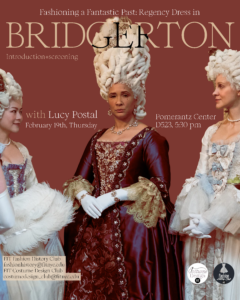
Screening of Bridgerton (2026), introduced by fashion historian Lucy Postal
This screening of an episode of Bridgerton (2026), introduced by fashion historian Lucy Postal, was co-hosted by FIT Costume Design Club. Her introductory presentation explored how costume design shapes the show’s world-building, arguing that Bridgerton functions as fantasy rather than historical drama—and that its intentionally inaccurate period dress has nonetheless sparked popular interest in fashion history. Postal is an MA candidate in Fashion and Textile Studies at FIT, with research focused on women’s historic dress and experience in museum and fashion archiving.
Flyer by Anika Sud
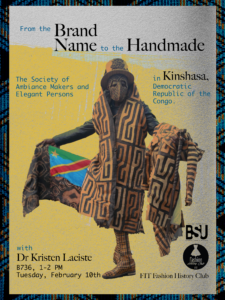
“From Brand Name to the Handmade: The Society of Ambiance Makers and Elegant Persons in Kinshasa, Democratic Republic of the Congo” with historian Kristen Laciste
Dr. Kristen Laciste’s presentation focused on members of the Congolese fashion subculture, the Society of Ambiance Makers and Elegant Persons (La SAPE), who are locally and internationally known for wearing expensive outfits from European and Japanese designer brands. Members of La SAPE are frequently depicted donning Western-style suits, leather shoes, and sometimes walking canes and smoking pipes. However, there are members of La SAPE who make their own ensembles to show that elegant outfits can be made locally and need not come from abroad.
Flyer by Anika Sud
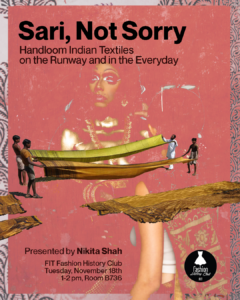
“Sari, Not Sorry: Handloom Indian Textiles on the Runway and in the Everyday” with artist and scholar Nikita Shah
Shah’s presentation traced the journey of the handloom sari from an everyday garment to a site of fashion, identity, and resistance.
*Flyer by Anika Sud*

Guided tour of Dress, Dreams, and Desire: Fashion and Psychoanalysis with MFIT director & chief curator Valerie Steele
The final program of the club’s Fall 2025 calendar of events was a guided tour of the Museum at FIT exhibition Dress, Dreams, and Desire: Fashion and Psychoanalysis led by Dr. Valerie Steele, director and chief curator of MFIT.
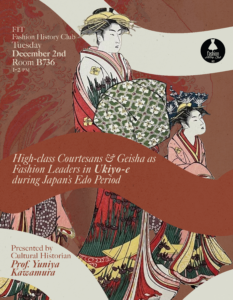
“High Class Courtesans and Geisha as Fashion leaders in Ukiyo-e during Japan’s Edo Period” with cultural historian Yuniya Kawamura
This presentation given by cultural historian and FIT educator Yuniya Kawamura, focused on fashions of the Japanese Edo period (1603-1868), challenging the idea that the fashion system we know today is solely a Western one.
Flyer by Anika Sud
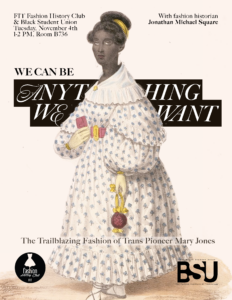
“We Can be Anything We Want: The Trailblazing Fashion of Trans Pioneer Mary Jones” with historian Jonathan Michael Square
Dr Michael Square’s presentation covered the life and fashions of Mary Jones, a black transgender pioneer in nineteenth-century America, who dressed herself in the fashions of the 1830s—bustles, shawls, and bonnets. This presentation revealed that despite criminalization and repeated imprisonment, she was dedicated to her feminine self presentation. This event was hosted in collaboration with FIT’s Black Student Union.
Flyer by Anika Sud
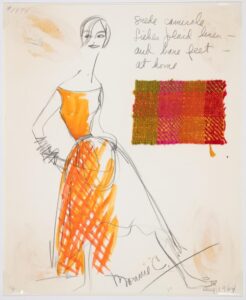
“The Textiles, Fashion, and Friendship of Dorothy Liebes and Bonnie Cashin” with design historian Charlotte von Hardenburgh
Charlotte von Hardenburgh, a design historian and FIT educator, gave a talk on her research into the work of Bonnie Cashin & Dorothy Liebes, highlighting the interplay between fashion and textiles. The event was held in collaboration with FIT Special Collections and College Archives, creating an opportunity for students to engage with the research materials housed at FIT.
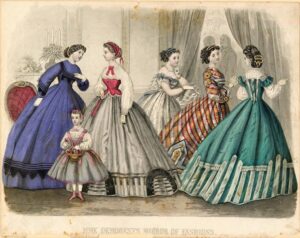
“Bloomers on Bow Street and Criminals in Crinolines” with fashion historian Summer Anne Lee
For the club’s first on-campus meeting, we welcomed fashion historian and FIT educator Summer Anne Lee as our first guest speaker. She shared her tantalizing research on the connections between Victorian crime and women’s fashion for the Bow Street Police Museum Blog.
Speaking Engagements
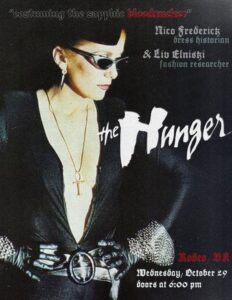
Costuming the Sapphic Bloodsucker in The Hunger (1983)
Alongside Dress Historian Nico Frederick, I spoke on costuming the Lesbian Vampire in film, followed by a screening of The Hunger (1983) starring Catherine Deneuve, Susan Sarandon and David Bowie. Our conversation began with the sapphic vamps predecessor, the early twentieth-century filmic archetype of the Vamp, embodied by Theda Bara and later Marlene Dietrich—ultimately culminating in Deneuve’s ultra-high fashion rendition. This event was planned and moderated by event programmer Anne Marie Dillon and held at Rodeo Bar in Brooklyn, New York.
*Flyer by Mila Rae Mancuso*
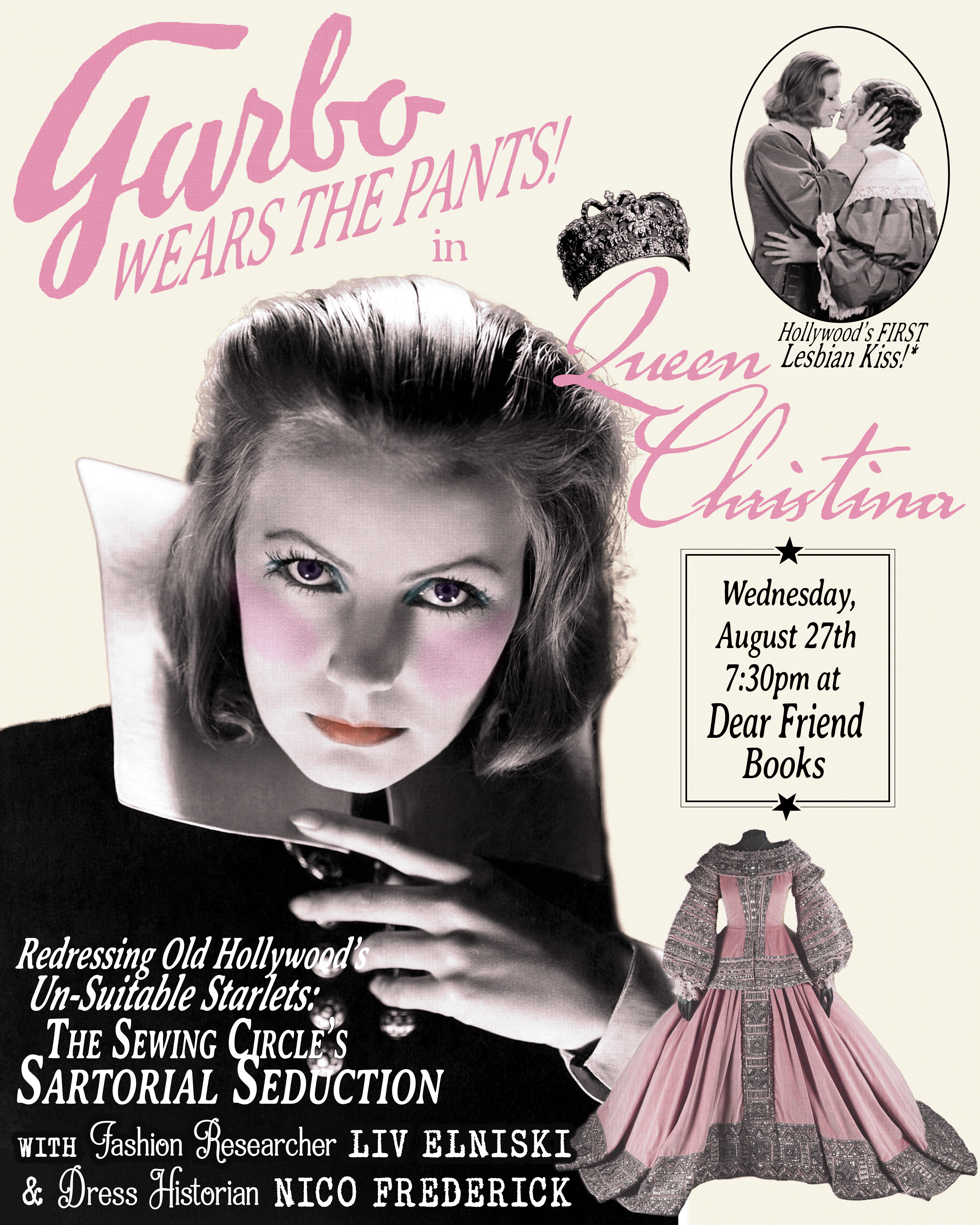
Garbo Wears the Pants in Queen Christina (1933): Redressing Old Hollywood’s Unsuitable Starlets
Alongside dress historian Nico Frederick, I spoke on queerness and deviance in pre-Hays Code Hollywood, how fashion in both film and mass-market retail shaped a gay and lesbian imagination in early 1930s America, and how costumes function as both a tool for queer-coding characters and enforcing historical (in)accuracies. The talk was followed by a screening of Queen Christina (1933) starring Greta Garbo with costumes by Gilbert Adrian. This event was programmed and moderated by film historian Andrea Torres of Film Forum and hosted at Dear Friends Books in Brooklyn, New York.
*Flyer by Laura Luciana*